
Java lies at the meeting point of the Indian Ocean and the Java Sea, with Borneo to the north, Bali to the east, and Sumatra to the west. A mountain chain runs across the island’s east–west axis, a result of the volcanic eruptions that formed the island and filled it with fertile soil. The island has long been a hub of long-distance trade activity. From at least the eighth century C.E., powerful Hindu-Buddhist kingdoms were established on the island, leaving a strong material mark. The famous temples of Borobudur and Prambanan, with their intricately carved sculptures, evince the island’s artistic significance (fig. 1). From this early era, textiles were important material goods in Java, serving as a key part of the economy and as ceremonial gifts and markers of social status, as depicted in the Borobudur reliefs (fig. 2).


Islam came to Java as a local religion in the first centuries of the second millennium, with Islamic tombstones in Old Javanese script attesting to the existence of local communities of Muslims by the fourteenth century. The religion became politically significant in the fifteenth and sixteenth centuries, with the formation and ascension of the Islamic Demak and Cirebon sultanates. The Dutch first visited Java in the late sixteenth century, and they formed the Vereenigde Oostindische Compagnie (VOC, also known as the Dutch East India Company) in 1602. After establishing a permanent trading post at Banten in West Java, the VOC inaugurated a governor general of the Dutch East Indies in 1610 to manage its political and economic affairs. The Republic of Indonesia declared independence in 1945, and the newfound state eventually chose the city of Jakarta (formerly Batavia), in Java, as its capital. While the nation is currently in the process of moving the capital to the newly established city of Nusantara, in Borneo, Java remains a vibrant center of art and culture where over fifty percent of Indonesia’s population make their home.
Textiles of Java
Java is particularly well-known for the production of textiles. Batik is a technique in which the pattern is either drawn by hand (batik tulis) or stamped with a block (batik cap). In batik tulis, an artisan uses an applicator known as a canting to draw designs in wax on the woven cloth. The textile is then dyed, and the wax resist creates the patterns. The wax can be scraped off, and the textile dyed again in several stages, producing schemes with various colors. Batik cloths are often used for dress.
Batik has a long history on Java. Tax-grant documents (sima charters) suggest that precursors to the technique may have existed as early as the twelfth century.1 Two blue-and-white cloths, which have been carbon-14 dated to between the thirteenth and fourteenth centuries and between the fourteenth and fifteenth centuries, respectively, are possibly among the earliest extant textiles patterned with batik.2 On both examples, a ground of woven Indian cotton is adorned with wax-resist designs that may have been produced on Java.3 But scholars believe it was not until the seventeenth century that batik as we know it today arose as an important art form in Java, and the earliest known use of the term batik is from that era.4 Other techniques used in Java are , , , and .
The Yale University Art Gallery’s collection of textiles from Java includes objects from three key regions: the courts of Central Java, known as the principalities; the north coast of Java, known as Pasisir; and the Kerek region, in East Java. These areas are quite distant from each other, with travel from one to the other taking hours, even today. West Java is even further removed. The Sundanese people of that area have their own batik tradition, in which the resist is often formed from the application of rice paste.5 The principalities of Central Java were formed under the Mataram Sultanate (1586–1755). By the eighteenth century, this once-powerful sultanate, which had held power over much of Java, was merely a vassal state of the VOC. When conflict broke out between competing factions of the Mataram rulers, the Dutch company brokered a treaty in which the sultanate was split into the principalities of Surakarta and Yogyakarta. These were later subdivided to make four principalities, with the establishment of the smaller princely states of Mangkunegaran and Pakualaman.
Batik textiles produced and worn in the principalities have been an important part of court culture (fig. 3) since the seventeenth century, when batik emerged as a prominent art form in Java. The batik traditions of Surakarta (also known as Solo) and Yogyakarta are particularly well known. These textiles exhibit a somber palate of blue (from indigo) and brown (from the soga tree) on a white background in Yogyakarta and on ivory in Surakarta. Examples from Surakarta tend to have intricate details in their iconography, while designs from Yogyakarta are bolder.

In the principalities, batik (usually hand-drawn batik tulis) was almost exclusively the dress of the court. Individuals not associated with the aristocracy only wore batik tulis during ceremonies, such as marriages and circumcisions.6 At court, the most prevalent garment was the waist wrapper (kain panjang), a rectangular cloth tied around the waist and hips to form a skirt. For special occasions, such as court ceremonies, a ceremonial waist wrapper known as dodot could be worn. At around 11 1/2 to 13 feet long and 6 1/2 to 8 feet wide, a dodot was four times the size of a typical hip cloth. Women wore a breast cloth (kemben) wrapped around their torsos. Men at court covered their heads with a square cloth known as iket kepala that was folded into a cap.7
At court, the use of batik was highly regulated. Already under the Mataram Sultanate, motifs and styles were associated with status and political allegiance.8 It was compulsory to wear batik at court.9 The designs worn by individuals were also regulated. In the eighteenth century, the Mataram court issued decrees that restricted the use of batik tulis with certain patterns to members of the royal family.10 Only batik colored with soga dye could be worn for court ceremonies.11 After the split of Mataram into the principalities, these sumptuary regulations became even more detailed. Certain patterns, such as the “broken dagger” (parang rusak) and “garuda wings” (lar), were prohibited (larangan) to most; they could be worn only by members of the royal family.
Though the principalities were, and continue to be, closely associated with batik, that is not the only area in which this technique was important. In fact, while early scholars believed that batik was invented in the principalities, it may have been practiced in an older form in the Pasisir coastal region, which stretches roughly from Cirebon to Surabaya.12 The wider Pasisir region was a place where people from different locales settled over its long history. During the era when Pasisir batik tulis was most widely produced, from 1880 to 1910, communities of Peranakan Chinese (the descendants of immigrants from southern China), Indo-European, Arab, and Javanese people, among others, filled the region, bringing with them their unique histories and traditions.
In contrast to the limited range of muted colors and abstract forms found on batik textiles from the principalities, Pasisir batik tends to feature variegated natural and geometric imagery (fig. 4). Members of various groups produced batik in the Pasisir region. Of particular importance were workshops run by Peranakan Chinese and Indo-European artisans. The Peranakan entrepreneurs became known for designs in vivid tones.13 The Indo-European entrepreneurs produced work in a style that scholars have termed batik Belanda.14 These examples often featured motifs inspired by European heritage, including scenes from fairy tales. Production of Pasisir batik was highly commercialized. Either men or women could run workshops, but it was almost always women who were hired to undertake the canting work on the cloth.

As in the principalities, the most prevalent garment in Pasisir was a cloth draped around the waist, of which there were two main forms: the hip cloth (kain panjang), and the sarong (sarung), which is sewn into a tube shape and pulled up over the legs. Both men and women wore these garments. In the nineteenth century, trousers became commonplace for men. Hip cloths, sarongs, and trousers were all made of batik textiles. The technique was also used for head coverings worn by Muslim men (iket kepala), shoulder cloths for women (selendang), and shawls that covered a Muslim woman’s head and shoulders (kudhung). On the upper body, women wore blouses (kebaya), and men and women donned jackets (baju). These garments, however, were produced from chintz, imported cotton, or velvet rather than batik.
Textiles from the Kerek region were produced under entirely different circumstances. Kerek is a rural region of East Java, consisting of several remote hamlets. The Gallery holds the collection of Rens Heringa, who studied cloth in Kerek between 1976 and 1990, when, she claimed, the area was the last region of Java still to produce handwoven textiles in the traditional manner.15 In this period, textile designs were deeply meaningful to their owners. Patterns, colors, and compositions indicated the age, sex, and status of wearers, as well as the particular villages in which they lived (fig. 5). Clothing may have once been similarly meaningful throughout all of Java.16 As such, the textiles of Kerek may help shed light on the historical dress of the larger island.
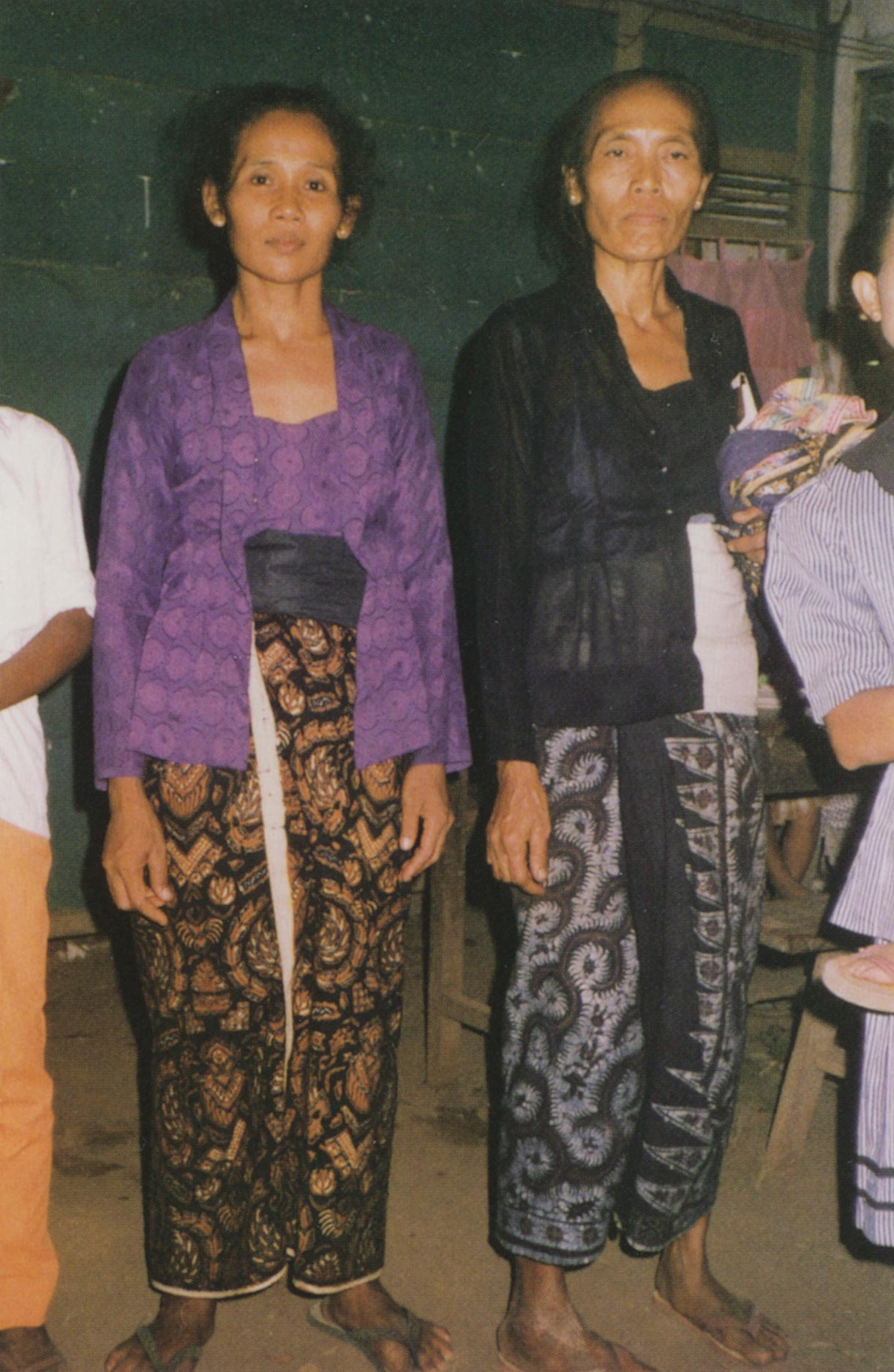
Batik tulis (hand-drawn batik) was one of many types of textiles produced in Kerek, and typically only the owners of sawah (irrigated rice fields) wore skirt cloths made with the technique, while women of all social groups wore batik shoulder cloths.17 The Kerek region also produced textiles with the batik lurik technique, which was worn by commoners. Batik lurik are checked textiles decorated with batik dots. The Kalang, descendants of the original inhabitants of Kerek, who had once lived in the forest, were known to wear textiles with batik lurik, a technique unique to Kerek in the modern era. Influential landowners known as bakalan wore textiles with simple patterns produced in the ikat resist technique (lurik taenan). The owners of tegal (dry cultivation fields) wore cloth with small flowers produced in warp float (for men) or weft float (for women), called lurik kembangan.
The color palette of Kerek batik tulis consists of reds, blues, and purples, originally produced with the natural morinda and indigo dyes, later with naphthol and synthetic indigo. The colors were deeply meaningful.18 Traditionally, the lighter and brighter the color of a batik garment, the younger the wearer; conversely, older wearers were expected to wear darker cloth. Geography, however, could complicate these associations. The darkest textiles were also connected to the northern hamlets of Kerek, where they could be worn by younger women.19 The semiotic meanings of Kerek textiles reveal the deep importance of these objects to facilitating social structures. Heringa’s unparalleled opportunity to study, document, and collect this material when it was still in production illuminates our understanding of the social meanings of textiles in this region and, perhaps, historically throughout Java.
Notes
-
Jan Christie noted that, already in the eleventh century, a textile type called bananten was produced by being washed and pounded, much in the way that contemporary batiks are prepared for the application of wax; see Christie, Jan Wisseman. “Texts and Textiles in ‘Medieval’ Java.” BEFEO 80 (1993): 181–211., 190. ↩︎
-
Sardjono, Sandra, and Christopher Buckley. “A 700-Years Old Blue-and-White Batik from Indonesia.” Fiber, Loom and Technique 2 (2022): 64–78.; and Sardjono, Sandra. “An Early Blue-and-White Batik.” In Interwoven Journeys: The Michael Abbott Collections of Asian Art, ed. James Bennett and Russel Kelty, 29–33. Adelaide: Art Gallery of South Australia, 2023.. ↩︎
-
Boow, Justine. Symbol and Status in Javanese Batik. Nedlands, Australia: Asian Studies Centre, University of Western Australia, 1988., 28; and Christie, Jan Wisseman. “Texts and Textiles in ‘Medieval’ Java.” BEFEO 80 (1993): 181–211., 192. ↩︎
-
Djajasoebrata, Alit. Flowers from Universe: Textiles of Java. Volendam, Netherlands: LM, 2018.. ↩︎
-
Boow, Justine. Symbol and Status in Javanese Batik. Nedlands, Australia: Asian Studies Centre, University of Western Australia, 1988., 30. ↩︎
-
Majlis, Brigitte Kahn, “Javanese Batik: An Introduction.” In Batik: From the Courts of Java and Sumatra: Rudolf G. Smend Collection, 11–15. Singapore: Periplus, 2004., 11. ↩︎
-
Boow, Justine. Symbol and Status in Javanese Batik. Nedlands, Australia: Asian Studies Centre, University of Western Australia, 1988., 14. ↩︎
-
Boow, Justine. Symbol and Status in Javanese Batik. Nedlands, Australia: Asian Studies Centre, University of Western Australia, 1988., 30. ↩︎
-
Boow, Justine. Symbol and Status in Javanese Batik. Nedlands, Australia: Asian Studies Centre, University of Western Australia, 1988., 31. ↩︎
-
Boow, Justine. Symbol and Status in Javanese Batik. Nedlands, Australia: Asian Studies Centre, University of Western Australia, 1988., 31. ↩︎
-
Veldhuisen, Harmen C. Batik Belanda, 1840–1940: Dutch Influence in Batik from Java; History and Stories. Jakarta: Gaya Favorit, 1993., 23. The word Pasisir comes from the Old Javanese pasisi or pasir, or Indonesian pesisir, meaning “shore” or “coast.” ↩︎
-
See, for example, the early twentieth-century waist wrapper, Yale University Art Gallery, inv. no. 2018.24.1, https://artgallery.yale.edu/collections/objects/217255. ↩︎
-
On these textiles, see Veldhuisen, Harmen C. Batik Belanda, 1840–1940: Dutch Influence in Batik from Java; History and Stories. Jakarta: Gaya Favorit, 1993.. ↩︎
-
Heringa published her work on Kerek in several books, the most comprehensive of which is Heringa, Rens. Nini Towok’s Spinning Wheel: Cloth and the Cycle of Life in Kerek, Java. Los Angeles: UCLA Fowler Museum of Cultural History, 2010.. Her work on the batiks of Kerek is the most important inquiry into the topic. ↩︎
-
Roy W. Hamilton, in Heringa, Rens. Nini Towok’s Spinning Wheel: Cloth and the Cycle of Life in Kerek, Java. Los Angeles: UCLA Fowler Museum of Cultural History, 2010., 8–9. ↩︎
-
On the relationship between social group and textile types, see Heringa, Rens. Nini Towok’s Spinning Wheel: Cloth and the Cycle of Life in Kerek, Java. Los Angeles: UCLA Fowler Museum of Cultural History, 2010., 20–21. ↩︎
-
On the meanings of colors in Kerek batik, see Heringa, Rens. Nini Towok’s Spinning Wheel: Cloth and the Cycle of Life in Kerek, Java. Los Angeles: UCLA Fowler Museum of Cultural History, 2010., 34–39. ↩︎
-
On the relationship between color and geography, see Heringa, Rens. Nini Towok’s Spinning Wheel: Cloth and the Cycle of Life in Kerek, Java. Los Angeles: UCLA Fowler Museum of Cultural History, 2010., 42–43. ↩︎